
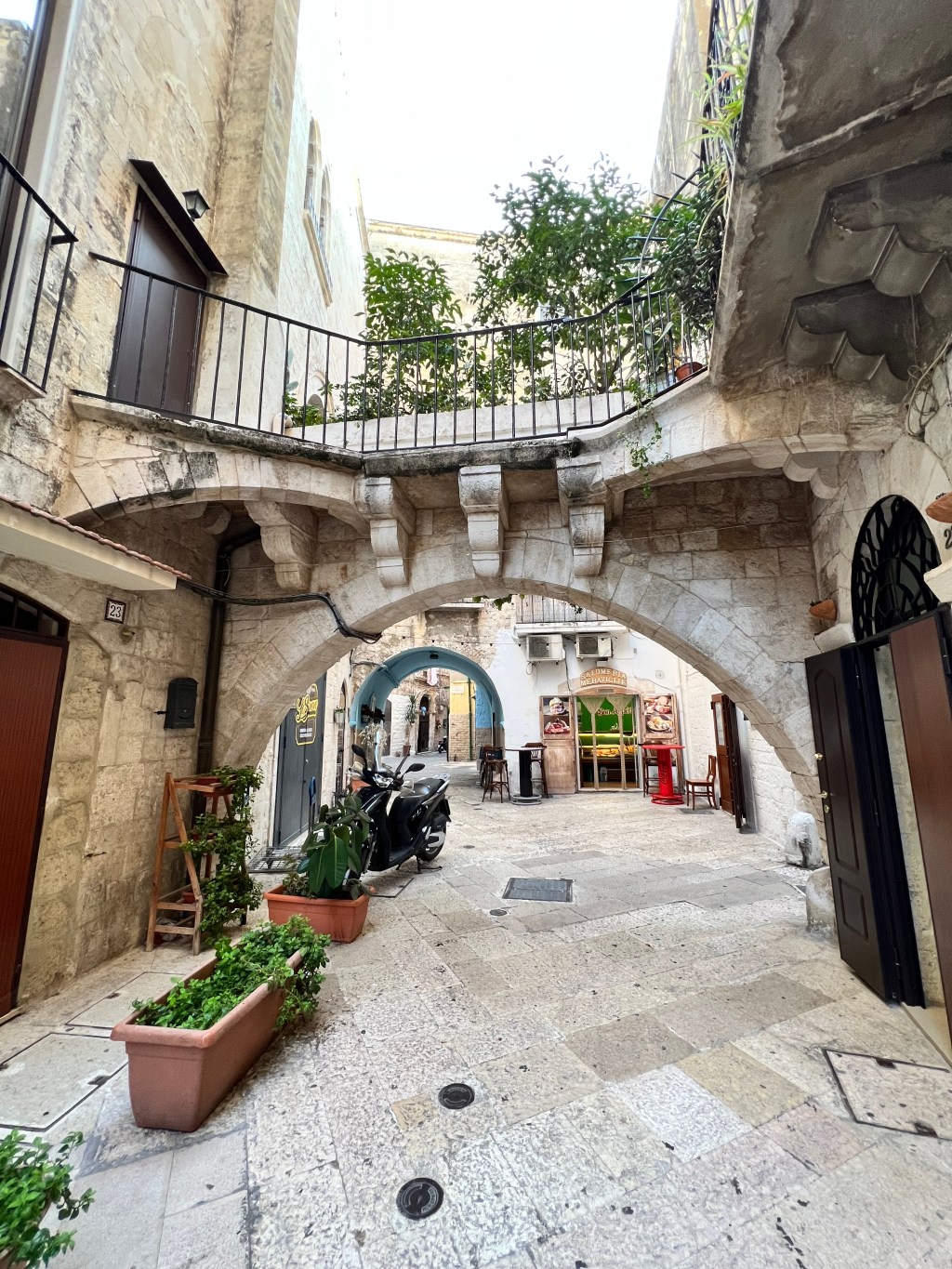
Bari is the capital of the region of Puglia, which forms the “heel” of Italy’s boot. It also has the largest port on Italy’s Adriatic coast. While you may not hear much about this coastal city, we found it to be one of our favorite! It is not as big as the typical touristy destinations like Rome, Milan, or Naples, but it has plenty of history, and a vibrant city life with a laid back slower pace. And overall we found Bari much more affordable than other hotspots in Italy. There are charming winding streets through the old town, a beautiful coastline, spectacular food, a great promenade and pedestrianized shopping area, and a city that is very welcoming!


Exploring Bari
One of the best ways to understand any Italian city is to get lost in the city’s old town and Bari is no exception. We fell in love with strolling the narrow winding streets and this old town is famous for something special, and that is orecchiette!
The word orecchiette means “little ears” in Italian. And in Puglia, orecchiette refers to a kind of handmade pasta that that is typical of the region and of course, shaped like small ears.
So as you are strolling the streets of the old town and directly across the entrance to Bari Castle, you will find the area of Bari referred to as “Orecchiette Street” or “Strada delle Orrechiette”. And while this is not the streets official name you will quickly understand why!
As you walk along Arco Basso street (lower arch street) you will see homes opened up and the ladies of Bari setting up shop outside their doors. With ground-floor kitchens that open up directly to the street, these sweet ladies at Orecchiette street will greet you with smiling faces as you watch them sing songs and diligently work on kneading their dough and shaping these iconic ear shaped pasta.

Above the streets you will see their laundry hanging out to dry while the mesh screens on wooden trays are full of pasta drying below.

This was definitely one of the highlights of our time in Bari was seeing this age old tradition of pasta making! And it goes without saying that you will find plenty of restaurants with their specialty being dishes of orecchiette on the menu!


Nom Nom Nom
And since we are on the topic of pasta there was one restaurant that we fell in love with and that was Terranima. Its farm to table passion comes to life as soon as you walk into the door. It is definitely a local spot and has a warm and welcoming atmosphere and the food was outstanding. We even met one of the owners at the end of hte meal and Pete proclaimed this to be the best bowl of pasta he’s had it all of Italy! (And that is saying a lot because we have had a LOT of pasta!)


Now lets talk about the other highlights we saw while in Bari!
It goes without saying that every historic Italian town has the must see basilica and cathedral and Bari is no different! But while the cathedral is usually the highlight, the Basilica of San Nicola may be the showstopper here!
Step Inside The Basilica di San Nicola
One of the best places to visit in any city is usually its Cathedral. Yet, in Bari’s case, the Basilica of San Nicola is the church that steals the Cathedral’s thunder. For good reason.
The Basilica of St. Nicholas (Basilica di San Nicola) is an important religious site for both Roman Catholics and Orthodox Christians. Built in the 11th century as a safe haven relics of Saint Nicholas. And today you can even visit the crypt where these are held – it is located below the first floor of the Basilica.


Who exactly is Saint Nicholas? And if you are thinking Santa Claus in the back of your mind you will be surprised to know you are on the right track! They both are celebrated as gift givers!
Nicholas is the patron of sailors and voyagers and there are stories that tell of Nicholas saving his people from famine as an example but there are many other great acts he is noted for. But most of these stories are of him doing these generous deeds in secret, expecting nothing in return. Within a century of his death he was celebrated as a saint.
The Saint in Bari
In the spring of 1087, sailors from Bari succeeded in spiriting away the bones, bringing them to Bari, a seaport on the southeast coast of Italy. An impressive church was built over St. Nicholas’ crypt and many faithful journeyed to honor the saint who had rescued children, prisoners, sailors, famine victims, and many others through his compassion, generosity, and the countless miracles attributed to his intercession. The Nicholas shrine in Bari was one of medieval Europe’s great pilgrimage centers and Nicholas became known as “Saint in Bari.” To this day pilgrims and tourists visit Bari’s great Basilica di San Nicola.
https://www.stnicholascenter.org
While visiting the basilica we even got to be unexpected guests at a local wedding that was taking place!


The San Sabino Cathedral
The San Sabina Cathedral began construction in the late 12th century and is a beautiful example of Apulia Romanesque Architecture. It is located at the Odegritria Square and while it may not be as famous as the nearby St. Nicholas Basilica, it is still something not be be skipped. The cathedral is dedicated to Saint Sabinus and has a beautiful rose window that I found fascinating! Each year something extraordinary will occur on the day of summer solstice (June 21). Sunlight will pass through the rose window of the facade of the cathedral and will overlap the the marble mosaic of the floor.


Castello Svevo – The Castle of Bari
Between the old dockyard and the Cathedral is Bari’s seaside castle. This coastal fortress once protected the old city, and now is open to the public and home to a museum with rotating special exhibits. While we have visited many historic castles during our travels, one of the most unique parts of this place was how they have introduced a digital visualization within the castle itself. As you walk through the rooms of this enormous fortress, you will see video projection on the walls of what life would have been like back in the 12th century.


A little taste of home!
You don’t go to Italy without feasting on Italian food at almost every meal while on vacation. But for us, our situation was a little different. While we love Italian food, since leaving the US in January we have been to 11 countries and have been in Italy for almost 2 months. So when we ran across this restauarant in Bari, it was calling our name. The decor was a Wild West Texas theme and while some may think it was over the top, it was a perfect place for us to get a burger, fries and a beer! This was actually our first hamburger in 9 months! And, it was delicious!
Bari is a great city and would definitely recommend to include it on your Puglia itinerary, you can easily add day trips to surrounding areas in the region like Polignano a Mare or Alberobello. If you haven’t read our previous post we visiting those areas and you can read about them HERE.
Below is a side story about the devastation that has happened to the Olive Oil industry in the Puglia region of Italy:
Puglia and the devastating epidemic that has killed over a third of the region’s iconic olive trees
Puglia is probably most famous for its olive oil production with its 60 million olive trees producing more than 40% of Italy’s olive oil (and an estimated 12% of the worlds olive oil!). This regions temperature and long dry summers and warmer winters are the perfect climate for Italy’s treasured olive groves.
What you may not be aware of is that about 10 years ago a devastating thing happened, the bacterium Xylella fastidiosa entered into Italy and has devastated this industry. Before Italy knew what was happening and were able to control this bacterium, it spread like wildfire infecting an estimated 20 million trees, mostly in the region of Puglia.
How it happened: As this bacteria reproduces, it creates a gel that clogs the channels in these plants, preventing water and nutrients from passing through. Once infected, the bacteria essentially chokes the life out of the tree as it slowly starts to die.
So what once was lush olive groves from as far as the eye could see, has now turned into a sad barren wasteland of dead trees.

It was one of the saddest scenes we saw throughout our tour of Italy. From what we understand, the issue has been contained. And as I was writing this post I did some research on what is in store for Puglia’s olive oil industry going forward and I was happy to see that there have been great efforts to save groves that have not been completely destroyed as well as plans to reinvest in these farmlands. So hopefully the next time we visit the area will be back to it’s glory
 The Modern Nomads
Leave a comment